
Skip to content
Silvena RoweLongevity Nutrition Academy

By Chef Silvena Rowe

Honorary Professor of Practice

Longevity Nutrition Academy

See food differently.

Learn for everyday life. Develop the skills to support others.

The narrator’s voice, the music and the imagery were made with AI tools. Chef Silvena Rowe appears in her own recorded lectures. Audio in English; English and Bulgarian subtitles available.

Your path from food science to coaching practice

Explore the food. Understand the evidence.

Build your foundation in seven modules, then bring that knowledge into four modules of coaching practice. Silvena's teaching and regional kitchen work connect the science to everyday food choices.

01Start with food and a purposeChoose a food-learning question and explain what this course can help you do.

Parts

  1. Start with a meal you know

  2. What longevity nutrition can explain

  3. A pattern that fits a life

02Understand the food on your plateExplain the different jobs of foods and build two balanced meals in your own food context.

Parts

  1. Protein: the score and the plate

  2. Carbohydrate, fibre and the order you eat

  3. Fats in the pan and on the plate

  4. Small nutrients and everyday drinks

  5. Two different meals can both make sense

03When ingredients meetExplain how preparation and a food combination can change a meal while keeping the limits of the evidence clear.

Parts

  1. Broccoli, heat and a pinch of mustard

  2. Beans, greens and an iron question

  3. Turmeric, pepper and the 2,000% line

  4. Reading her recipes like a chef

  5. Change an ingredient without losing the point

04Food, metabolism and the gutExplain a practical food change using basic metabolic and gut concepts without promising a personal result.

Parts

  1. Fuel, five numbers and the person eating

  2. Thirty-eight trillion at the table

  3. Fibre, ferments and what is still alive

  4. One swap, explained at home

05Food in the rhythm of a dayBuild a feasible daily food routine and explain how timing evidence does and does not apply to it.

Parts

  1. Silvena's day on one clock

  2. The clock inside the meal

  3. Lunch, breakfast and the studies behind them

  4. Moving dinner in a real week

06Read a food claim and keep the foodInvestigate a nutrition claim and communicate a useful food choice without overstating the evidence.

Parts

  1. Her lists and her miracle foods

  2. From a rat to a person: mechanism, marker, outcome

  3. The food is not the extract

  4. Questions to ask before the jar goes in the basket

  5. A headline, its correction and the review that weighs it

07Make it work in everyday mealsBuild, explain and revise a complete three-day food-learning plan that fits a real practical constraint.

Parts

  1. Nine lives, one larder

  2. Taste, money and the freezer

  3. Three days, not three dishes

  4. When the plan meets the week

08Use the nutrition science in a real conversationExplain a person’s food question using the relevant course science and identify when further expertise is needed.

Parts

  1. Protein, mTOR and the question in front of you

  2. Pregnancy, teenagers and the same plate

  3. Strength, stairs and the menopause years

  4. A doctor's advice, turned into dinner

09Begin a coaching conversationConduct an opening conversation that hears the person’s priorities and agrees one realistic food-related goal.

Parts

  1. What this conversation is, and what it is not

  2. Let them say it first

  3. Expensive, unnecessary, won't fit

  4. One goal, in their words

  5. The people in the cases are invented. Their breakfasts, night shifts and Sunday pastries are the kind you will hear about.

10Turn goals into everyday food actionsHelp the person choose and test a practical food-related action while preserving food meaning and the agreed coaching boundary.

Parts

  1. Ask about the kitchen before the plate

  2. Change the dish, keep its job

  3. Fit the plan into a real week

  4. Explain one idea plainly

  5. Try it, then revise it together

11Follow up and review your practiceReview progress with the person, adjust the next step and document an appropriate follow-up or handover.

Parts

  1. What happened, not how well

  2. When the follow-up turns medical

  3. The note, and what it teaches you

  4. Joanna, Lena, Karim, Rosa and Dev are made up for the practice. Their soup pots, tablets and fasting months are the kind that turn up at a second conversation.

English course · 11 modules · Learn at your own pace.

Two ways to learn

For your life. For your work with others.

01 / Foundation · 5–7 hours planned

Longevity Nutrition Course

Understand ingredients, food combinations and nutrition evidence. Build a practical food plan for yourself and your household. No previous training required.

Planned award
Certificate of Completion

02 / Coaching pathway · English now available

Certificate in Longevity Nutrition Coaching

Build on the foundation to support people with everyday food choices and habits. Practise listening, agreeing realistic goals and reviewing progress within clear professional boundaries.

Planned award
Certificate of completion · GCLS award approval pending

Open to curious minds

One foundation. Many ways to apply it.

In your setting

Medical and clinical professionals

Physicians, nurses, longevity and preventive medicine clinics, dietitians and allied health practitioners. Build food and nutrition understanding for clearer professional conversations.

Example application

Explain a food claim and identify when specialist input is needed.

Chef Silvena Rowe holding a finished plate

Meet your course creator

Culinary experience. An educator’s perspective.

Chef Silvena Rowe brings culinary practice and nutrition education together. An Honorary Professor of Practice at the University of Food Technologies in Plovdiv and a lecturer at GCLS, she helps learners connect ingredients, flavour and food combinations with the evidence behind everyday choices.

Chef Silvena Rowe

Honorary Professor of PracticeUniversity of Food Technologies, Plovdiv

GCLS · Award approval pending

A lasting mark of achievement.

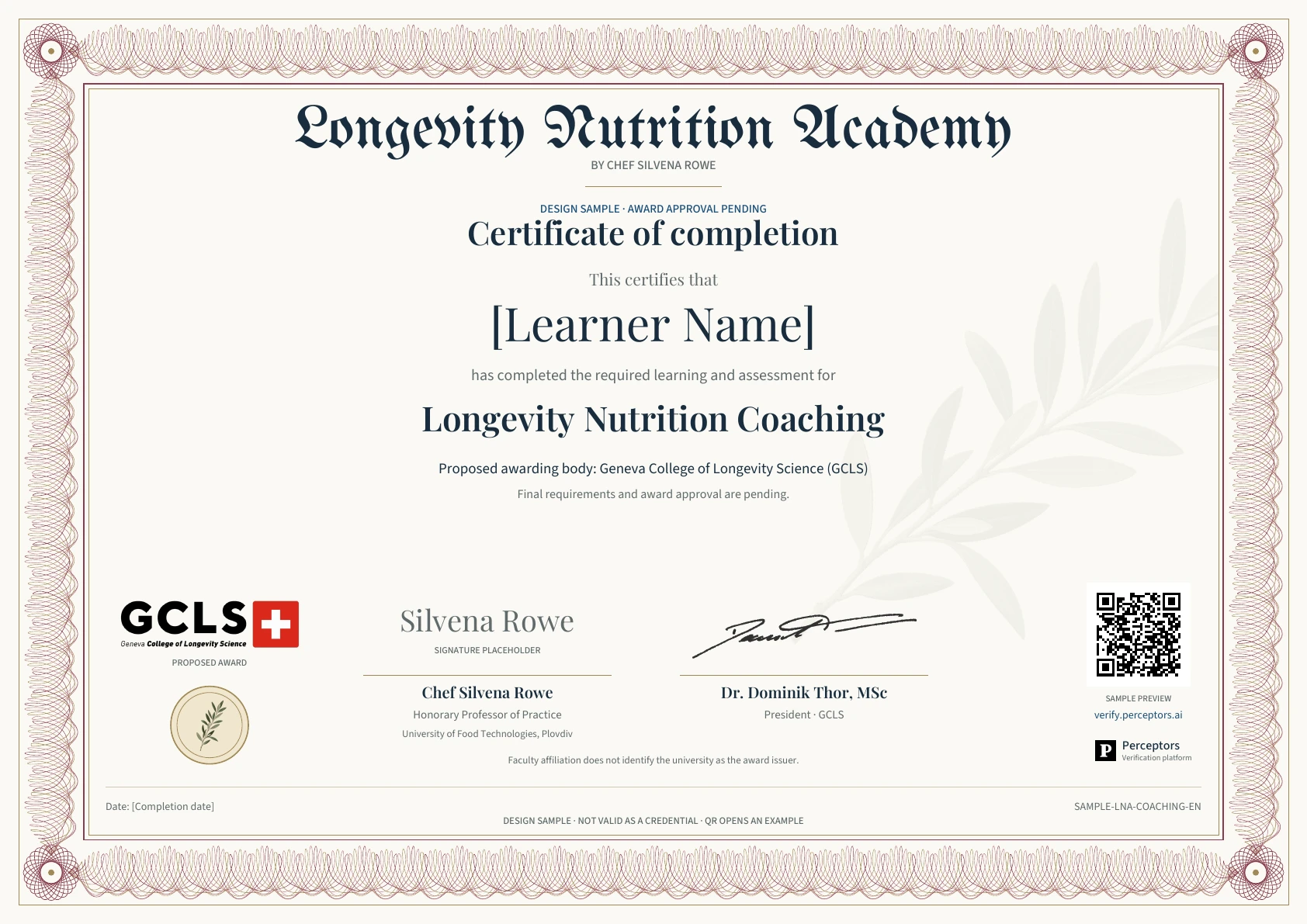
Share your certificate of completion on LinkedIn. Each issued certificate carries a unique QR code and verification code so its authenticity can be checked online, at any time.

Sample coaching certificate with a scalloped border, olive branch medallion and watermark, learner name and signature areas
Design sample · Not an issued credential

A few things to know

Who is the academy for?

The foundation welcomes anyone interested in food and longevity nutrition, including individuals, families and professionals. The coaching pathway is for people who want to support others with everyday food choices and habits.

Can I enrol now?

Yes. Enrol in the English coaching course for a one-time payment of US$399. Sign in with your email, complete secure checkout and begin learning. Bulgarian and Arabic editions are being finalized.

How will the learning adapt to me?

Your role and goals will help shape examples and optional practice. The foundation focuses on applying knowledge in your own life. The coaching pathway adds optional practice supporting others.

What will I need to do to earn a certificate?

For the GCLS coaching certificate, complete the course and pass the final quiz with at least 80%. There is no required practical assessment, capstone or viva.

What does the coaching certificate recognise?

The GCLS award recognises completion of this programme and its final quiz. It does not confer a clinical licence, dietitian registration or automatic recognition in any country. Silvena’s university title is her personal affiliation; the university is not presented as the issuer. GCLS is the awarding body.

Is this a cooking course?

Recipes help explain ingredients, food combinations and nutrition evidence. The emphasis is on understanding food and applying that knowledge. Cooking demonstrations are not part of the planned format.

A new way into nutrition

Bring food knowledge into your world.

English course · One-time payment · 11 modules